Archivo de la categoría: Equipo

Publicaciones acerca del equipo para tiro con arco

Talones Beiter

Beiter Nocks.

Beiter nock guide -> Nocke_GB

Hola a todos, aquí les presento un nuevo artículo después de una larga espera.

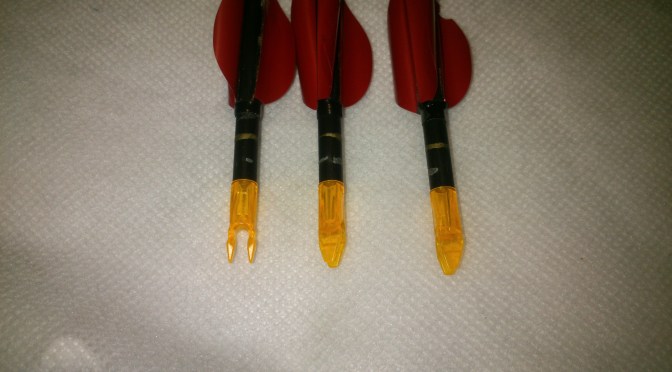
Este fin de semana estrené por primera vez mis talones Beiter, unos 12/2 para mis A/C/E. Debo decir que me sorprendieron desde el momento que los instalé. Un ajuste suave y preciso en la flecha, un agarre a la cuerda limpio. En mis 10 años de tirar había dudado de que fueran tan diferentes del G-nock, que equivocado estaba. Los utilicé para tirar un control local FITA 1440, y fueron instalados la noche anterior al evento, sin cambiar ningún aspecto de la afinación del arco.

Les quiero comentar que desde Enero, no he podido entrenar tanto como quisiera por diferentes razones económicas. Mi entrenamiento se vio reducido a práctica de tiro con una liga. No por despreciar este ejercicio, pero créanme que no es lo mismo.

Primero les puedo decir que mis miras subieron cerca de 4.5mm a 90m, 4mm a 70m, 3mm a 50m y 2mm a 30m. Esto significa que es mucho más eficiente en su funcionamiento, específicamente es más limpio el momento de soltar la cuerda. Tomen en cuenta que esto provoca que la flecha actúe más suave, por lo que las miras se cargaron un poco a la derecha (soy arquero diestro).

Pero de nada sirve que suban las miras si el grupo no se mantiene o mejora. Bueno este es precisamente el punto. A pesar de que no he podido entrenar mucho desde Enero, me sorprendió que estos talones me ayudaran a agrupar como lo hicieron. Les hablo de grupos del tamaño del amarillo a 90m, cuando con los G-nock me estaba costando trabajo agrupar dentro del 7. Fue muy sorprendente que a 70m los grupos eran más pequeños que mis puños, en repetidas ocasiones. Esto a mi me habla de que el talón Beiter no sólo es más limpio en la soltada, que no sólo hace más rápida la flecha, sino que también me perdonó bastante, lo suficiente como para tirar la mejor puntuación de la categoría Mayor, y la 5ª mejor del Control con mi limitado entrenamiento.

Quiero resaltar que Beiter se dedica a la manufactura de piezas plásticas de alta precisión y calidad. En lo personal no dudaba de la manufactura del talón, sino de que su desempeño fuera tan diferente al de uno de los talones más constantes del mercado. Sin embargo al voltear al circuito internacional son pocos los que no utilizan talones Beiter, y ahora sé por qué. Otro punto importante es el costo de los talones. Ronda entre 1usd-1.4usd/pza en la tienda que elijan. Si bien no es un talón económico les quiero decir que si se quieren dedicar seriamente al tiro con arco este es prácticamente un requisito. Los únicos talones que creo que podrían competir con él son el Easton Pin-nock y el nuevo Soma Pin-nock. El precio para estos talones es similar al del Beiter.

La razón de por qué estos talones pueden competir es porque:

·         Son del mismo material, policarbonato. Tienen la mima rigidez. A diferencia del G-nock, que es más suave y puede provocar distorsión.

·         Tienen las mismas prácticas de manufactura. Un molde por color, lo que hace que las tolerancias se mantengan al mínimo.

·         Tienen un diseño que permite un desempeño eficiente y limpio.

Una gran ventaja de los talones Beiter es que sin importar el talón utilizado todos tienen la misma forma. Por lo que si cambias de flecha puedes seguir utilizando los talones que ya sabes cómo se desempeñan. Hay talones para cualquier cantidad de flechas, desde aluminio, carbón, aluminio-carbón, pin-nock. Esto los hace la única línea de talones disponible para toda la gama de flechas. Y es la única geometría de talón constante en toda la gama.

Que buen producto, en lo personal no volveré a los G-nock para competencia, y probablemente no utilice otro talón.

Sigan entrenando duro,

JLZenizo

Hello everyone, here I bring this new article after a rather long wait.

This weekend I used for the very first time my Beiter nocks, a 12/2 Inside nock for my A/C/E. I want to say that they blown me away from the moment I installed them. A smooth and precise insertion into the shaft, a very clean pinch onto the string. In my 10 years of archery I had doubted that they were so much different form the G-nock, how wrong I was. I used them to shoot a FITA 1440 round in a local qualifier, I installed them just the night before, without any other change of tuning.

I want to state that my training has been diminished since January for economical reasons. It’s been reduced to a rubber band shot practice. And not to speak ill of this type of training but it is never the same.

First I want to say that my sight marks got raised 4.5mm @90m, 4mm @70m, 3mm @50m and 2mm @30m. This tells me that this nock is more efficient, especially at the release from the string. Take in account that this promotes a softer arrow behavior, which in turn moves the sight to the right (I’m a right-handed archer).

But it serves no purpose to have better range if the grouping doesn’t keep the same or improves. Well this is exactly the point. In spite of my reduced training it took me by surprise that this nocks helped me group as they did. I’m talking about grouping the size of the yellow rings at 90m, when with the G-nock I was struggling to keep it inside the 7 ring. Even more surprising that at 70m the grouping was smaller than my fist in several occasions. This tells me that the Beiter nock has not only cleaner at string release, which makes a faster arrow, but also makes it more forgiving. Forgiving enough to shot the best score out of the open category, and the 5th best score from all 90m shooters, again with my limited training.

I want to point out that Beiter has a long history of high precision, high quality plastic manufacture. Personally I had no doubt about the nocks quality and manufacture, but about that the behavior being that different from one of the market’s most constant nocks. And when you look at the international circuit there are very few archers that do Not use the Beiter nock, now I know why. Other important fact is the pricing. It swings around from 1usd/piece up to 1.4usd/piece. As this is not a low cost nock I think that if you’re taking archery seriously you should consider using this nocks as a most. The only nocks I believe that could compete with this are the Easton and Soma Pin-nock. With same price to the Beiter nock.

The reasons I consider these a plausible competitor are as follows:

·         They are made from the same material, Polycarbonate. They have the same rigidity. G-nock is a little softer material which can be subject to distortion at the shot.

·         They have the same manufacture good-practices. One cavity per color to reduce tolerance to a minimum.

·         They have a design that allows for a clean and efficient release.

A great advantage of the Beiter Nock is that no matter the nock you are using, they all have the same geometry. So when you should change your arrows you have practically the same nock which you already know how it behaves. There are Beiter nocks for almost any arrow available from aluminum, carbon, aluminum-carbon and Pin-nock. This makes them the only nock for the complete range of arrow shafts. And is the only nock geometry constant to all the nock range.

What a nice piece of Equipment. Personally I won’t use G-nock for competition, and probably won’t use any other nock.

Keep the hard training.

JLZenizo

Plumas

Vanes and feathers

Hola a todos, esta vez le presento un artículo solicitado por un lector y amigo.Plumas, qué diferencia hay, como se usan y cuál es la indicada para la aplicación. 

Primero vamos a dividir las aplicaciones. Hay dos categorías principales, Cacería y Precisión. Y precisión se puede subdividir en Exteriores e Interiores (Indoor).


Empezaremos por la categoría más sencilla, Indoor. Se requiere que las plumas brinden la mayor estabilidad y corrección posible en la reducida distancia de 18mt. Para ello casi no importa el tamaño, forma o material de la pluma. De hecho entre más grandes y lentas sean mejor. Es común encontrar plumas naturales, así como emplumados helicoidales de 2° o más. Todo independientemente de si es Poleas o recurvo. Cuiden los problemas de interferencia con el arco.


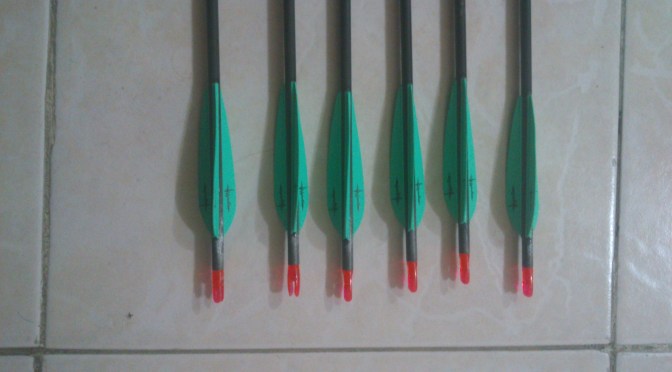
Para cacería los requerimientos son diferentes. En general se requiere que la flecha vuele lo más rápido y silencioso posible, rara vez se realizan tiros de 50mt o más, y se requiere que la flecha se estabilice lo más pronto posible. Esto nos lleva a usar plumas sintéticas, de longitud moderada (2.5’’-4’’), perfil bajo y emplumados de 1°-2° de inclinación. A menor ángulo, menor ruido pero requiere más distancia para estabilizar la flecha. Una pluma demasiado pequeña puede no estabilizar nunca. Consideren el requerimiento de espacio de la repisa. Entre más grande la punta, mayor debe ser la pluma


Precisión de Exteriores. Es probablemente uno de los temas más extensos en los que se puede sumergir un arquero. Hay plumas suaves, rígidas, super-rígidas; plásticas o de Mylar, rectas, Spin, perfil complejo. Cada pluma tiene sus ventajas y desventajas, así como sus aplicaciones recomendadas. En general se recomienda un ángulo de emplumado de 1° para obtener un desempeño adecuado.

·         Las plumas suaves se usan principalmente para las flechas de aprendizaje e intermedias. Esto porque son las más baratas y comunes en el mercado. No aptas para alta precisión ya que al ser suaves se distorsionan a altas velocidades, casí como ver una bandera ondear al viento, además de ser propensas a daños por otras flechas y deformación por almacenaje.

·         Las plumas rígidas plásticas se recomiendan para arqueros intermedios-avanzados, que requieren de mayor precisión y velocidad para las distancias largas. Un gran ejemplo de estas plumas son las Flex-Fletch.

·         Las plumas tipo Spin de Mylar (spin-wing, Kurly vane, Ely vane, etc) han sido las más utilizadas por los arqueros de alto perfil desde su introducción. Son plumas de perfil reducido gracias a su curvatura, además de presentar un espesor mínimo. Sin embargo todo tiene su costo, estas plumas son las más delicadas, un golpe con otra flecha, atravesar una paca, una mala afinación, una mala soltada, o agrupar demasiado cerrado daña este tipo de plumas. Las hay de formas tradicionales (spin-wing y kurly vanes en forma de gota) o de perfiles modificados (Ely vanes de perfil parabólico, XS-wings de perfil tipo escudo). Todas son altamente efectivas y requieren de un cierto grado de técnica para alcanzar su desempeño.

·         Las de perfil modificado. Esta es una categoría relativamente nueva. Plumas como la Impulse, las aerovanes, etc. Plumas que han introducido nuevas filosofías al mercado. La impulse diseñada para sustituir a las de mylar, de forma y tamaño diseñados para mejorar la eficiencia de la pluma plástica. La aerovane utiliza varias zonas de diferentes espesores, simulando un ala de avión esperando crear un efecto de elevación que haga girar más rápido la flecha.

En mi caso comencé utilizando pluma suave, 1.75’’ de gota, platiflech. Después utilicé la flexfletch FFP-187, plástica rígida con forma de escudo. Actualmente utilizo Spin-wing o kurly vane de 1.75’’ o las impulse vanes de 3’’. Emplumo mis flechas con 1° de inclinación, y las spin las emplumo con la pinza Beiter para mejor comodidad y rápidez.


Lo importante es que prueben todas las opciones posibles.  Hay muchos que tiran Indoor con plumas de mylar, hay plumas de mylar para cacería. Traten de encontrar la pluma que mejor se adapte a su estilo y necesidades.


Saludos y sigan entrenando.

JLZenizo

Hello everyone, this time is an article requested by a friend and follower.Vanes and feathers, what difference, how they’re used and for which applications. 

Fist we are dividing them into two main categories, Hunting and Precision. Then Precision is divided into Outdoor and Indoor.


We’ll start with the “easiest” category to explain, Indoor. You need a vane/feather that give the most stability and forgiveness possible for the 18mt given. Almost not minding the size, shape or material. In fact as bigger and slower they are, the better. It is common to see natural feathers, as well as helical fletching with 2° offset or more. This regardless if the bow is recurve or compound. Watch for clearance issues.


For Hunting the requirements are quite different. In general you need the fastest and quietest arrow you can build, there are rarely 50mt or more shots, and you need the arrow to stabilize as fast as possible. All this takes us to mainly vanes, of moderate length (2.5’’-4’’), low profile and a 1°-2° fletching offset. At a lesser offset degree less noise, but you need a longer stabilization distance. A vane too small might never stabilize the arrow. Consider the clearance requirements. The bigger the broadhead the bigger the vane needed.


Outdoor precision. This is probably one of the most extensive subjects for an archer. Mainly vanes, there are soft, rigid, super-rigid; plastic or Mylar; straight, Spin or complex profile. Each vane has its pros and cons, as they have their recommended uses. In general its recommended a 1° offset to get an adequate performance.

·         Soft vanes are recommended mainly for beginners, intermediate and leisure or club arrows. This because they are the cheapest and easiest to find in the market. Not very good for high precision or speeds, as they are so soft that they flap like a flag on a post, distorting the arrow flight. Also very prone to be damage by other arrows and because of a poor storage.

·         Plastic rigid vanes are recommended for intermediate and advanced archers requiring more speed and precision for longer distances. A great example of this type of vanes are the FlexFletch vanes.

·         Spin Vanes, Mylar (Spin-wing, Kurly Vane, Eli vane, etc.) have been the type of vane selected for most top archers since their introduction. These have reduced profile thanks to their kurled shape altogether with the minimum thickness available. But all this good comes not without a dark side, these vanes are the most delicate. An impact against another arrow, a shoot-though, a poor tuning, a sloppy release or even good grouping will damage this vanes. They come in various shapes from the traditional drop shape (spin-wing, kurly-vane) or modified profiles (Eli and GAS with parabolic, XS-wings shield shape). All are highly effective and require a certain grade of technique to achieve and harvest their potential.

·         Modified profile. This is a relatively new category. Vanes like the Impulse, Aerovane, etc. These vanes have introduced new philosophies into the market. The impulse designed to replace Mylar vanes, with shape and profile improved for a rigid plastic vane. The Aerovane has different thickness areas trying to mimic an airplane wing, expecting to achieve a grade of aerodynamic elevation effect that makes the arrow spin faster without increasing the drag of an increased offset angle.

In my case I started using the flexible plastifletch, drop shape 1.75’’. Then I moved to Flex-Fletch FFP-187, rigid plastic vane with shield shape. Now I use Spin-wing or Kurly-vane 1.75’’, or Impulse 3’’, all fletched with 1° offset. The spin type I use the Beiter Wing Holder for faster and easier fletching.


The important thing is that you try and test as much as possible. There are who shoot Indoor with small mylar vanes, there are Mylar vanes for Hunting also. Try to find the vane or feather that better suits your style and needs.


Best regards and keep training.

JLZenizo