Archivo de la etiqueta: archery

Ajuste del botón – detalles finos

Plunger Adjustment – fine details

Hola a todos. En este nuevo artículo abordaremos un tema un poco más técnico, el ajuste del botón, específicamente un botón Beiter, para lograr un mejor comportamiento del grupo.

Este artículo no explicará cómo se ajusta un botón, o hasta qué punto se considera afinado correctamente. Lo que haré será explicar mis observaciones durante el ajuste fino del botón, considerando las diferencias que presentan los resortes disponibles.

Cuando uno adquiere un botón de presión éste incluye un instructivo, que incluye una gráfica de ajuste de los diferentes resortes incluidos.

Hello everyone. In this new article we’ll discuss a more technical topic, the plunger adjustment specifically the Beiter plunger, in order to fine-tune the grouping.

In this article we won’t explain how a plunger is installed and adjusted. What I’ll do is explain my findings during fine-tuning of the plunger considering the differences of the different springs supplied.

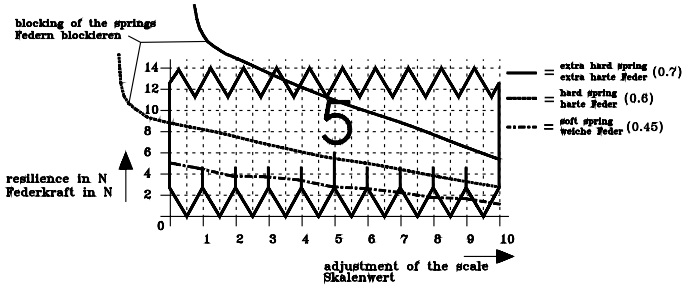
When one buys a Beiter plunger it includes its manual, that has a graph of the behaviors of each supplied spring for the plunger setting.

boton_beiter

En ella vemos la escala de ajuste, de 0-100, misma que está grabada en nuestro botón. El eje vertical es la fuerza que ejerce el botón para cada resorte. Por último tenemos las curvas de comportamiento de los tres resortes (suave, duro, extra-duro) a lo largo de todo el ajuste del botón.

Podemos observar que hay dos zonas que yo considero importantes. Son dos regiones en las que dos de los resortes tienen un traslape. La primera es entre el resorte suave y el duro, entre los 3-5 N. La segunda región es la de los resortes duro y extra-duro en los 5.5-9 N. En estas dos zonas podemos generar la misma fuerza con ambos resortes, útil cuando estás afinando unas flechas nuevas y necesitas cambiar el resorte para poder seguir afinando el botón.

Sin embargo el comportamiento será diferente, ya que el resorte más duro requiere menos compresión para generar la misma fuerza.

Esto es importante porque nosotros afinamos el botón de acuerda al comportamiento. Es decir de acuerdo a la fuerza con la que responde el botón durante el disparo. Tan es así que la afinación la hacemos de acuerdo con el comportamiento del grupo y las desplumadas. Esto se refleja en que si requerimos una respuesta de 8N de parte del botón podemos obtenerla de dos maneras:

  • Con el resorte Duro @12
  • Con el resorte Extra-Duro @ 78

Con ambos tendremos una respuesta de 8N, misma que agrupa las desplumadas en el grupo de emplumadas. En el primer caso la flecha se tiene que pandear más que en el segundo caso, y es esa diferencia la que puede ayudarnos a cerrar el grupo. Un resorte más duro ayudará a cerrar el grupo, uno más suave les ayudará a perdonar errores.

Personalmente encuentro que me responde mejor un resorte más duro, con menos pandeo de la flecha. También he encontrado que mi mejor grupo es con flechas “rigidas”, reporta flechas desplumadas a la izquierda, pero prefiero romper talones de emplumadas que afinar las desplumadas en el grupo.

Ustedes que opinan? Manden sus comentarios.

Saludos y sigan entrenando.

The horizontal axis is the plunger setting, 0-100 as engraved in the plunger barrel. The vertical axis is the force that the spring imprints to the arrow. Finally we have the force curves for each spring (soft, Hard and Extra-Hard) along the barrel setting of the plunger.

And we can observe two zones that I consider quite important. These are regions in which two springs overlap their behavior. The first is between (S-H) in the neiborhood of the 3-5 N. The second region is between (H-XH) for 5.5-9 N. In this two zones we can generate the same force with both springs, usefull when you’re tunning the plunger and run out of adjustment for a given spring and you have to change to the next one, you can then adjust the new spring from the same point of the last one.

Although we won’t have the same behavior from the two, as the softer from the pair will require more compression to achieve the same reaction force than the harder.

This is important because we try to tune for a given behavior. This means we tune to find the reaction force that best suits our shot. And this is as true as we tune our bow to group the stripped arrows inside the group, trying to match both behaviors. This reflects that if we require a response of 8N from the plunger we can obtain it in two ways:

  • Hard spring @12
  • Extra-Hard spring @  78

With both we get 8N, which makes a single group of stripped and complete arrows. But in the first case the arrow will bend more than in the later, and this could be the difference that makes a tighter group. A harder spring tends for tighter grouping; a softer one tends to be more forgiving.

Personally I find myself more comfortable with a harder spring, less arrow bending. I’ve also found that I can group better with a “stiff” arrow behavior (stripped to the left, as I’m right-handed). But I rather break nocks than tune in the stripped arrows.

What say you? Send your coments.

Best regards and keep on training.

Reglas del Juego

Rules of the Game

Hola a Todos, espero estén muy bien. Perdonen por no escribir pero mi arco había sufrido una rotura y estaba trabajando duro en ello.

Hace dos meses, cuando hice mi primer Robin-hood, a 70m nada menos, uno de mis compañeros me hizo el comentario de que esas flechas se anotan como “miss” ya que no llegan a la carátula. Esto me puso a pensar, ¿Cuántos de nosotros hemos leído y comprendido el reglamento que nos rige? ¿Cuántos de nosotros estamos preparados para defendernos de interpretaciones erróneas como esa?

El reglamento dice (libro 3: Target Archery):

14.2.6.3 –“Si la flecha golpea a otra en la paca y queda clavada en la flecha, recibirá el valor de la primer flecha”

14.2.6.4 –“La flecha golpeo a otra pero queda en la paca, esta se puntúa de acuerdo a como cayó en la carátula”

14.2.6.5 –“La flecha golpea a otra y cae al suelo tendrá el mismo valor que la flecha golpeada, asumiendo que se pueda identificar plenamente”

Podemos ver que en ningún caso se puntúa como “miss”, excepto que la flecha caiga fuera de la diana o golpee a una que lo esté. Por otra parte las reglas al respecto son bastante obvias en mi opinión. Esto me pone a pensar si le habrán hecho trampa alguna vez. Y a cuantos más también en otros aspectos.

Considero que debemos tener el mayor conocimiento posible del reglamento para poder defenderse en caso necesario, así como evitar gastar dinero en accesorios no permitidos, etc. Creo que cuando no conoces el reglamento no sabes cómo les estás dando ventaja a tus contrincantes. Que te quiten un accesorio en la revisión de equipo, o te descalifiquen en la final por falla de uniforme, por mencionar algunos casos, es otorgar la victoria por default. Recomiendo que lo consideren parte de su entrenamiento, tan importante como tirar.

En lo personal considero que parte de la belleza de este deporte es que no importa el nivel del evento, siempre se usa el mismo reglamento, el mismo equipo que usan los grandes campeones en los más prestigiados eventos.

Les dejo los links a la sección de reglamentos de World Archery para que los tengan a la mano.

WA-Rules

WA-Bylaws

Saludos y sigan entrenando duro.

JLZenizo

Hello everyone, sorry for the delay but my bow’s central stabilizer bolt broke down and I was working hard on bringing it back to health.

Two months ago when I shot my first Robin-hood, at 70m no less, one of my teammates said that that type of eventualities are scored “miss” since the arrow doesn´t lands on the target face. This got me thinking, how many of us really have read and know the rulebook that we play by? How many of us are really prepared to defend ourselves from miss-interpretations like this one?

Rulebook says (book 3: Target Archery)

14.2.6 –“An arrow hitting:

14.2.6.3. Another arrow in the nock and remaining embedded therein shall score the same value as the arrow struck.

14.2.6.4. Another arrow and deflecting into the target face shall score as it lies in the target face.

14.2.6.5. Another arrow, and then rebounding, shall score the value of the struck arrow, provided the damaged arrow can be identified.”

We can see that in any case it is scored a “miss”, unless the value corresponds. On the other hand, the rules for these case scenarios are quite obvious, don’t you think? This gets me thinking if he has suffered such cheating. And how many others in different aspects.

It is my consideration that we should have as profound knowledge of the rulebook as we can to be able to defend ourselves if necessary, as well as avoid costly forbidden accessories, etc. I think that when you don’t know your rules you don’t know how much advantage you’re giving to your competitors. Being stripped from a forbidden accessory in the equipment check, or being disqualified from medal final because of uniform issues, just to mention some cases, is like giving a default victory. I recommend that you consider knowing your rulebook as important as shooting in your training routine

It is my personal opinion that part of the beautifulness of this sport relies on the fact that it doesn’t matter the tournament, it plays by the same rules and with the same equipment used by the best in the greatest events

I leave you the links to the rulebook at World Archery.

WA-Rules

WA-Bylaws

Best regards and keep on the hard training

JLZenizo

Miras, ¿qué diferencia hay?

Sights, what’s the difference?

Hola a todos, ¿Qué tal están tirando?

Hace unos días un vendedor me sugirió cambiar mi mira, de una Sure-Loc Contender-X a una Axcel Achieve-RX. Las razones que me daba eran que es una mira de ajuste más preciso y una construcción más robusta. Me puse a pensar si tenía razón, ya que la mira que uso ya tiene bastante tiempo, y posiblemente algo de desgaste.

Lo primero que hice fue revisar mi mira para saber en qué condición se encuentra. Regularmente le doy un mantenimiento cada 6 meses, la limpio y lubrico, aprieto todos los tornillos que deben estar apretados y reviso que las piezas que pueden sufrir desgaste no estén demasiado gastadas y que tenga un recorrido suave en cada eje y con cada click. Mi mira está en muy buenas condiciones.

Después realicé una pequeña investigación, les presento mis resultados y conclusiones.

Comparativo de productos:

Basado en la información publicada en Internet se obtuvo la siguiente tabla.

Hello everybody, how is your shooting going?

Some days ago a dealer suggested me to change my sight, from my Sure-Loc Contender-X to an Axcel Achieve-RX. The reasons he gave me were that it is a sight with more precise adjustments and more robust construction. And it got me thinking if he was right, mostly because my sight has some mileage, and possibly some wear.

The first thing I did was to check the wear state of my sight. I regularly give it maintenance every six months, I clean and lubricate it, lock the screws that should be locked and check the wear parts not to be too damaged and that the sight has a smooth travel on each axis and with each click. I feel confident that my sight is in very good condition and is as reliable as ever.

Afterwards I made a little research; I give you the results and conclusions.

Product Comparison:

Based on the information available on internet I got the following table.

Comparativo Comprison (Pulgadas/Inches)
Modelo

Achieve RX

AX4500 Quest-X Contender-X Ultima

Dual Click

Model
Marca

Axcel

Axcel Sure-Loc Sure-Loc Shibuya

Shibuya

Brand
Altura

4.375

4.5 5.5 5.5 4

4

Height travel
Extención

9

9 9 9 9

9

Extension
Resolucion-H

0.00156

0.00156 0.0020 0.0020 0.0016

0.0079

Resolution V
Resolución-V

0.00156

0.00156 0.0020 0.0020 0.0016

0.0031

Resolution H
Clicks/ciclo-V

20

40 10 10 20

10

Clicks/rev-V
Clicks/ciclo-H

20

20 10 10 20

10

Clicks/rev-H
Viaje/rev-v

0.0625

0.0625 0.0200 0.0200 0.0313

0.0787

Travel/rev-V
Viaje/rev-h

0.0625

0.0625 0.0200 0.0200 0.0313

0.0313

Travel/rev-H
Precio/Cost usd

360

295 350 260 340

300

Lancaster Archery
Precio/Cost usd

386

309 336 250 220

196

Alt Services
Opc. Al/Carbon Al/Carbon Al/Carbon Al/Carbon

Como pueden observar la diferencia más grande en términos de precisión es la cantidad de clicks por vuelta que ofrece Axcel. ¿Pero en realidad que diferencia ofrece una de la otra? Con la información disponible en internet hice la siguiente tabla.

You can see the real difference in terms of precision is the quantity of clicks per revolution of the Axcel sights. But how much difference is it really one from another? With the information available in internet I’ve gathered the following table.

Modelo Achieve RX AX4500 Quest-X Contender-X Ultima Dual Click Model
Marca Axcel Axcel Sure-Loc Sure-Loc Shibuya Shibuya Brand
Jalon

28″

28 28 28 28

28

arrow lenght
Extensión

9″

9 9 9 9

9

Extension
Adicional

1″

1 1 1 1

1

additional
total

38″

38 38 38 38

38

total
ajuste 0.00156″ 0.00156 0.00200 0.00200 0.00156 0.00787 adjustment
a 70m (mm)

2.87

2.87 3.68 3.68 2.88

14.50

at 70m (mm)

Como pueden ver no hay mucha diferencia en ajuste, ya que al transportar el ajuste de un click a 70m vemos que la diferencia entre mi Sure-Loc y las Axcel es de apenas 0.8mm, e incluso la Shibuya Ultima ofrece la misma resolución de la Axcel a una fracción del costo.

El otro atributo de Axcel es su extensión aligerada, que ofrece una reducida resistencia al viento, pero también tenemos esta característica en las Sure-Loc. Además comparado con el arraste que ejercen los estabilizadores o el maneral, creo que podemos no preocuparnos por una extensión sólida.

Espero que los datos sean de su utilidad y les ayuden a decidir que mira adquirir. Yo por lo pronto me quedo con mi Sure-Loc, si cambio de mira optaré por otra similar.

Saludos y sigan entrenando duro.

JLZenizo

As you can observe, there is not much difference in adjustments. As we translate them to the target at 70m we see that the difference between my Sure-Loc and the Axcel is only 0.8mm, and even the Shibuya Ultima offers the same resolution as the Axcel at a fraction of the cost.The other characteristic of the Axcel is its perforated extension for reduced wind resistance, but I have that in my Sure-Loc too. Besides compared to the drag from the stibilizers or the riser, I beleave we can avoid worrying about a solid extension, don’t you think?I hope this is useful to you and help you decide what sight to buy. Personally I’ll stickwith my Sure-Loc, when I change my sight I’ll choose something similar.

Best regards and keep up the hard training.

JLZenizo

Target Panic!!


Hola a Todos. Después de unas “vacaciones” forzadas de tres semanas aquí estamos de regreso, entrenando duro y con muy buenos resultados.

El otro día en la conversación cotidiana entre rondas surgió el tema del Target Panic. Como saber si uno lo tiene y como se soluciona.

Después de escuchar las opiniones e ideas de los demás les expongo mi proceso de solución, el cual me ayudó a mi y me ha permitido ayudar a otros en cuestión de horas o días.

El target Panic es un problema que llegan a tener muchos tiradores de todas las disciplinas. Surge del intenso deseo del tirador a acertar justo al blanco. El problema se puede presentar de varias maneras:

·         El tirador no puede ejecutar el tiro a menos que se encuentre apuntando justo al centro

·         El tirador no puede apuntar justo al centro

·         El tirador no puede permanecer apuntando al centro durante el disparo

·         Entre otros.

Hay personas que aprenden a vivir con ello y ajustan su técnica, apuntan compensado, tiran bajo la presión del tiempo, o sencillamente se conforman con no poder dar en el blanco.

Hay varios métodos y ejercicios propuestos, cada uno con su grado de éxito y el tiempo en que reflejan resultados. Ejercicios que varías desde práctica sin carátula, juegos como tirar poker, etc.

Mi método es bastante simple. Se basa en involucrar la mente consciente en el proceso de solución, y en general del tiro. Si bien la acción de apuntar debe ser subconsciente, ya que es la única parte del tiro que el cerebro sabe hacer realmente. Los pasos son los siguientes:

1.       Primero el tirador usará una distancia en la que se sienta seguro, en la que sepa que si falla no sucederá nada. En mi caso 30m es suficiente

2.       El tirador ajustará la mira para que los tiros peguen deliberadamente fuera del centro. Arriba o abajo, izquierda o derecha. Cada quien decide.

3.       Ahora el tirador se dedicará a hacer forma, apuntando al centro. Sabemos que los disparos no caerán en el centro, así que el ejercicio es a agrupar

4.       Una vez que el tirador puede agrupar fuera del centro, apuntando correctamente y sin sobresaltos, vamos regresando el ajuste de la mira, poco a poco. Cada ronda más cerca. Hasta que en unas 8 rondas el grupo vuelve al centro de la carátula

5.       Si el tirador vuelve a tener problemas o sobresaltos se puede regresar a cualquier etapa anterior.

Estos simples pasos me han ayudado a mi en varias ocasiones, y a muchos otros. Como pueden ver es tan simple como relajarse al apuntar y quitar el resultado de la ecuación. Y después añadir el resultado de nuevo, una vez que el tirador está cómodo tirando correctamente y apuntando al centro, pero ahora el tirador ha aprendido que el resultado no es tan importante como realizar correctamente el disparo, porque lo demás es un RESULTADO.

Espero les sea útil. Saludos y sigan entrenando duro.

Hello Everyone. After a 3-week forced “Vacation” we’re back, training as hard as always and with results reflecting it.

The other day during training, in the between-rounds conversation an interesting subject came up, Target-Panic. How to know if one has it and how to solve it.

And after hearing the different opinions and ideas from the others I bring you my personal method, which has helped me and others to overcome it in matter of hours or days.

Target Panic is a problem known to many shooters from all disciplines. It comes from the intense desire of the shooter to hit the center of the target. The problem can present in many variants:

·         The shooter can’t perform the shot unless he is aiming right on center of the target

·         The shooter can’t aim right on center of target

·         The shooter can’t keep aiming right center during the shot execution

·         Among others

Some people learn to live with it and adjust their technique, aiming off-center, shooting on the clock, or simply accepting they won’t be able to hit the target’s center.

There are various methods and exercises available, each one with its grade and time to success. Exercises vary from target-less practice, or games like shooting Poker, among others.

My method is quite simple. It is based on involving the rational mind into the process of the solution, and in general of the shot. Its known that in general the aiming should be subcontious as it is the only part the brain actually knows to do. The steps are as follows:

1.       First the shooter will go to a distance where he feels comfortable, in which he knows that if he misses there is no problem. In my case 30m is enough.

2.       The shooter will adjust the sight so he will hit out of the center deliberately. Up, down left or right is each one’s choice.

3.       Now the shooter will begin focus on shooting form, aiming to the center of target. We know he won’t hit the center, so the goal is to group the shots

4.       Once the shooter is grouping out of center, aiming correctly and with no jumps, we will now start to turn back the sight adjustment, a little each round. Closer and closer to center until after 8 round or so the group returns to the target center.

5.       If the shooter comes around with the problems again he can return to any prior step.

These simple steps have helped me in various occasions, and to many others. As you can see it is as simple as relaxing on aiming and removing result from the equation. And then adjusting the result back in, once the shooter is shooting correctly and aiming to the target center, but now the shooter has learned that the result isn’t as important as executing the shot correctly, because IT IS RESULT.

Hope it is usefull. Keep on hard training

JLZenizo

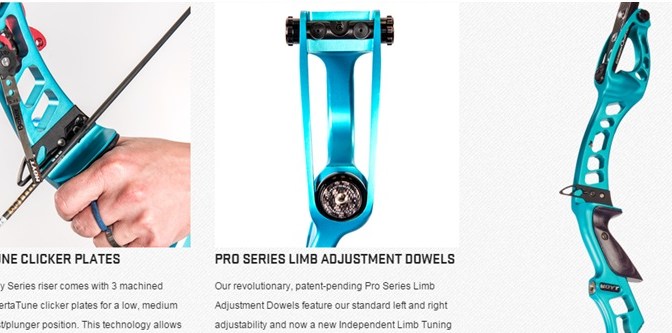
Hoyt Prodigy RX

Hoyt Prodigy RX


Hola a todos, Hoy me enteré de que Hoyt anuncia este nuevo maneral.Diseñado con la geometría del Formula RX y GMX, una geometría más deflex, diferente a los HPX, ION-X, y Prodigy, Prodigy XT, que son más réflex para favorecer una mayor velocidad.Recordemos que Brady Ellison fue prácticamente invencible con el RX, no así con el HPX. Una simple muestra de que uno se tiene que acomodar con su arco.

Les dejo la Pagina para que le echen un ojo.

Hello Everybody, today I found out that Hoyt has launched this new riser on april.Designed with a deflex geometry like the Formula RX and GMX, different from the reflex geometry of the HPX, ION-X, GPX and Prodigy, Prodigy XT that favors a higher speed.We can remember that Brady Ellison was almost invincible with the RX, but not quite with the HPX. An example that one has to settle with its bow.

Leave you the product page for you to check it out.

Prodigy RX

JLZenizo